In Kiruna, as elsewhere, the northern lights, or aurora borealis, are a physical phenomenon that occurs when electrically charged particles from the sun collide with the earth’s atmosphere. But under what conditions can they be seen? How can you maximize your chances of seeing the northern lights in Kiruna? How do you photograph them?
In this article, we’ll explain all the essential points you need to know so you’re ready to go hunting for them!
How to see the northern lights in Kiruna?
There are many ways to see the northern lights during your trip to Kiruna. Here are the main ones:
By car
If you plan to rent a car during your stay in Kiruna, you might like to plan an evening of northern lights hunting.
You’ll be able to go wherever you like to observe them, and you’ll have all the flexibility you need to move around and reschedule your hunt, for example.

However, if you don’t know the area, you may have trouble finding your way around and knowing what to look for…
Going with a professional guide
If you’d like someone to accompany you, you can book a guided tour. A guide will pick you up at your hotel and take you to a camp they have scouted in advance near Kiruna.
They’ll then show you how to set up your camera to capture the northern lights.

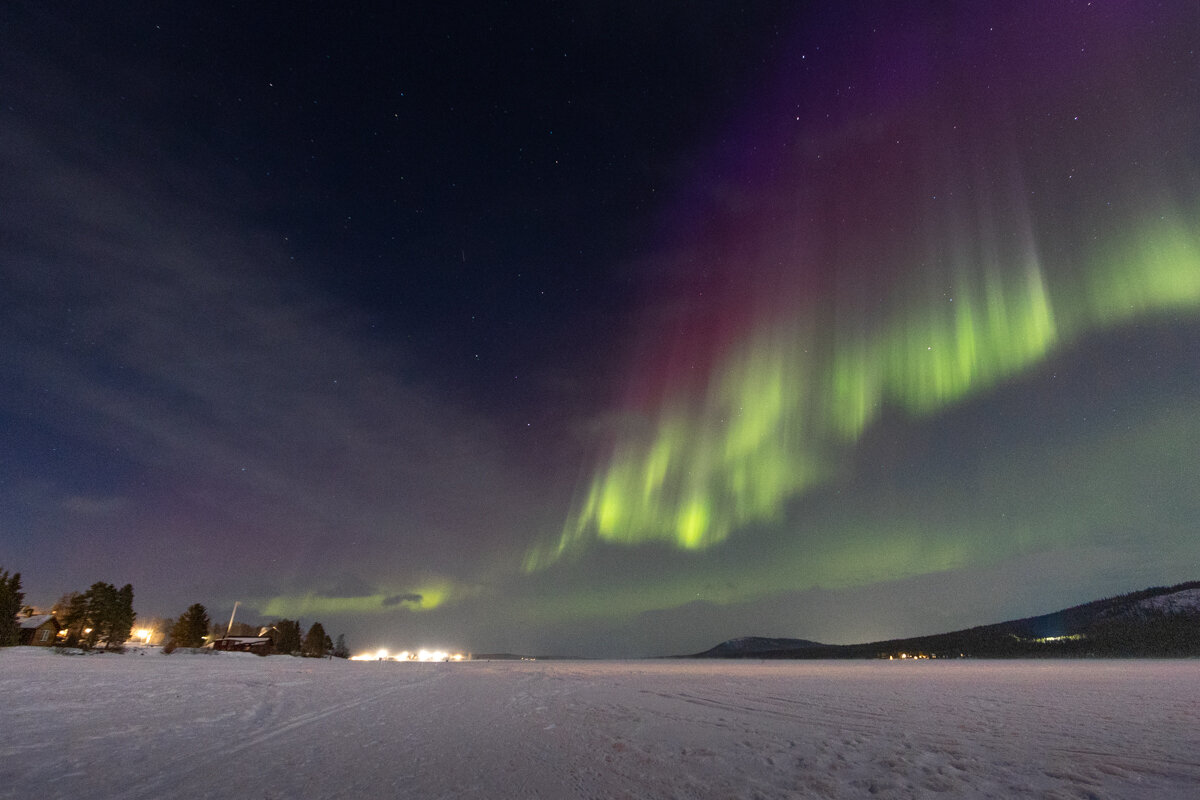
All you have to do is wait for the magic to happen and for them to appear, then capture them and enjoy the show around a campfire. The guide will also take photos of you and the northern lights, which you can get afterwards.
During an outdoor activity around Kiruna
There are also packages to combine northern lights viewing with an outdoor activity.
You can enjoy them from a dog sled or a snowmobile. You may not get to see this celestial phenomenon, but you’re sure to enjoy your activity in Kiruna!
Go on a northern lights hunt by minivan with a local guide, who drives you to the best viewpoints around Kiruna, far from artificial light. While you wait for the aurora to appear, you'll warm up with a hot drink and Lapland specialties.
Enjoy a memorable three-and-a-half-hour adventure! Climb aboard your snowmobile and ride through the snowy forests around Kiruna in search of the northern lights. Along the way, you'll take a break to enjoy the silence of the wilderness and a hot drink.
Embark on a unique hunt for the northern lights, wrapped up in a dog sled. You'll have all the equipment you need to keep out the cold, and by the light of the starry sky, you might just catch a glimpse of the famous northern lights.
Conditions for observing them
In Kiruna, the northern lights are visible from late August to mid-April. The best time to observe them is between 9 pm and 2 am, with the most impressive displays usually between 10 pm and 11 pm.
At Kiruna’s latitude, auroras occur on around 200 nights a year: they are frequent, but never guaranteed.
Factors to consider
Seeing them depends on several factors:
- Cloud cover: obviously, if there are too many clouds in Kiruna, you will not be able to see the northern lights, as they’ll be hidden. However, if they’re very intense, you can sometimes spot them through gaps in a partly cloudy sky.
- The Kp index: you can find out about geomagnetic activity (measured in Kp). It indicates how strong auroral activity is. The higher the index, the greater the chance of seeing them. For reference, as Kiruna is one of Sweden’s northernmost cities, you could well see some if the index is “only” 3.
- Luminosity: auroras are a million times less luminous than the sun. They can therefore only be observed at night, particularly when the moon is not very bright or even absent. So be sure to stay away from towns, as their ambient light can interfere with aurora viewing.


If you really want to give yourself the best chance of seeing the northern lights, consider taking a night flight. At cruising altitude, if the sky is clear and the conditions are right, you’ll have a prime spot to observe them!
Best places to see the northern lights around Kiruna
Here are the 3 best places to watch the northern lights in the Kiruna region:
- Kiruna: in Sweden’s northernmost town, you can book a tour operator to take you to see the northern lights. Otherwise, sometimes you just need to look up in the evening and enjoy the show, in a spot away from the city lights.
- Aurora Sky Station: located in Abisko National Park, about 95 kilometers northwest of Kiruna (around 1 hr 15 min by car), this remote site in the mountains is renowned for its clear skies. A chairlift takes you up to a tower dedicated to observing the northern lights.
- Jukkasjärvi: in this typical Swedish village 17 kilometers (about 20 minutes by car) east of Kiruna, you can easily find a secluded spot where you can sit back and admire the sky. Alternatively, the Icehotel offers safari packages to take you on a hunt for the northern lights.


Photographing the northern lights
The different colors observed for the aurora borealis in Kiruna and elsewhere, ranging from green to red to mauve, depend on the gases in the atmosphere (oxygen, nitrogen) and on altitude.
If you’re lucky enough to see an aurora borealis in Kiruna, you might want to capture the moment in a photo. In this section, we’ll give you all the information you need to take the most beautiful photos possible.
The equipment
Capturing an aurora borealis requires special equipment, without which you won’t be able to do it. Here’s the list:
- a camera capable of taking long exposures.
- a sturdy tripod (for windy conditions), essential for avoiding vibrations during the exposure.
- a wide-angle lens, capable of focusing to infinity. Otherwise, your camera won’t be able to auto-focus. Alternatively, take your lens with the highest depth of field and focus on the stars.
Optional: a remote shutter release, to further reduce vibration.


How to do it
Once you’ve got your equipment, all you have to do is wait for the moment to present itself. Don’t hesitate to install an app (most of which are free) on your phone, which will notify you as soon as the conditions for viewing the northern lights in Kiruna are right.
If the opportunity arises, you’ll need to be quick: sometimes, auroras don’t remain visible for long. You’ll need to have already set up your camera on its tripod, in a dark place with as little artificial light as possible.

As far as settings are concerned, open the aperture as wide as possible to let in as much light as possible. Focus as far as you can (on stars at near infinity, or even infinity if you have the right lens), otherwise your photo will be out of focus.
For ISO, aim for 400 to 800, to capture enough detail without the photo becoming grainy. You’ll need to increase the exposure time to between 10 and 25 seconds, depending on how quickly the aurora moves.
However, these two factors can be subject to considerable change. So keep an eye on these two settings!
You’ve now reached the end of the article dedicated to the hunt for the northern lights. You should now have everything you need to observe them in Kiruna!


